
-
Green Sapphire & Argyle Champagne Diamond Ring in 18K Yellow Gold – 1.63ct Oval Cut
Regular price $6,900.00Sale price $6,900.00 Regular price -
GIA 0.91ct Fancy Brownish Yellow Diamond Solitaire Ring in Platinum
Regular price $4,400.00Sale price $4,400.00 Regular price -
GIA 1.02ct Fancy Yellow Brown Diamond Ring in Platinum
Regular price $5,500.00Sale price $5,500.00 Regular price -
1ct Round Diamond Ring with Kite-Shaped Accents in 18K Yellow Gold
Regular price $13,500.00Sale price $13,500.00 Regular price -
1 Carat D VS1 Round Diamond Engagement Ring in 18k gold GIA certified
Regular price $10,500.00Sale price $10,500.00 Regular price -
1 Carat D VS1 Round Diamond Engagement Ring in Platinum GIA certified
Regular price $10,500.00Sale price $10,500.00 Regular price -
1 Carat D VVS1 Round Diamond Engagement Ring in 18k gold GIA certified
Regular price $17,500.00Sale price $17,500.00 Regular price -
1 Carat D VVS1 Round Diamond Engagement Ring in Platinum GIA certified
Regular price $17,500.00Sale price $17,500.00 Regular price -
1 Carat E VS1 Round Diamond Engagement Ring in 18k Gold GIA Certified
Regular price $10,300.00Sale price $10,300.00 Regular price -
1 Carat E VS1 Round Diamond Engagement Ring in Platinum GIA Certified
Regular price $10,300.00Sale price $10,300.00 Regular price -
1 Carat E VVS1 Round Diamond Engagement Ring in 18k Gold GIA Certified
Regular price $15,500.00Sale price $15,500.00 Regular price -
1 Carat E VVS1 Round Diamond Engagement Ring in Platinum GIA Certified
Regular price $15,500.00Sale price $15,500.00 Regular price -
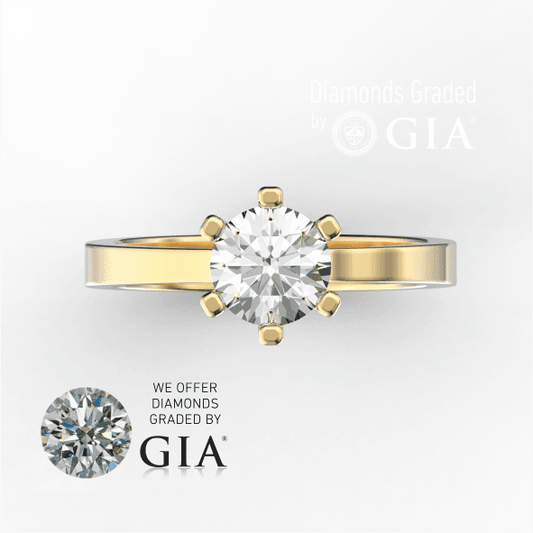
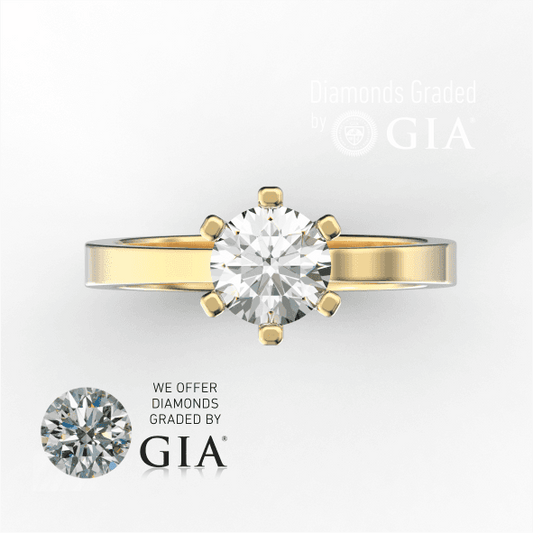
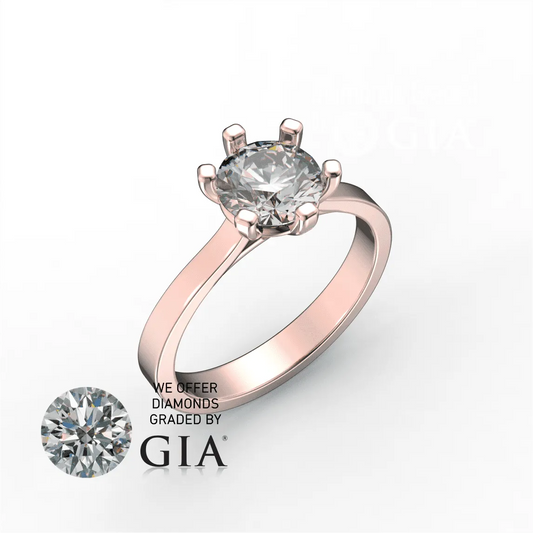
1 Carat G VS1 Round Diamond Engagement Ring in 18k Gold GIA Certified
Regular price $9,990.00Sale price $9,990.00 Regular price -
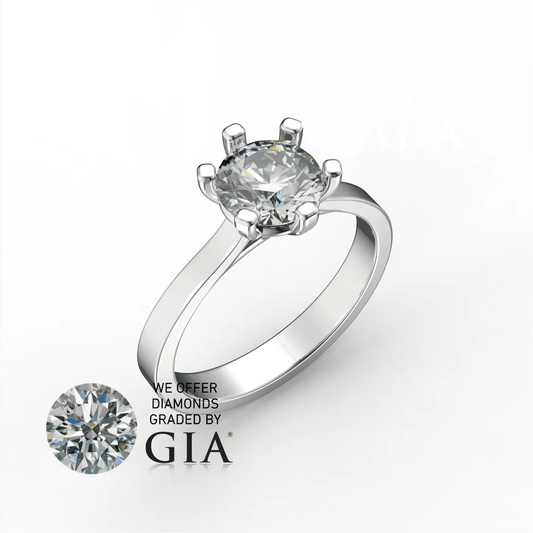
1 Carat G VS1 Round Diamond Engagement Ring in Platinum GIA Certified
Regular price $9,990.00Sale price $9,990.00 Regular price







Why Choose Gems and Gold for Your Diamond Engagement Ring
A solitaire places one diamond in direct conversation with the metal, without surrounding stones to add visual complexity. The stone is the entire statement. This is the most enduring and the most demanding setting style: the diamond's cut quality and character are fully exposed, and a well-chosen stone in a well-proportioned solitaire setting is one of the most refined things in fine jewellery. It suits those who value restraint and want the stone to speak for itself. [Explore Diamond Solitaire Engagement Rings]

A halo surrounds the central diamond with a frame of smaller stones, amplifying its apparent size and adding a crown of brilliance around the centre. The style has a long precedent in fine jewellery and remains one of the most consistently sought designs for diamond engagement rings - its appeal is a function of how effectively it works rather than fashion. A halo can be a single row of pavé-set diamonds or a more elaborate double halo, depending on the design. [Explore Halo Diamond Engagement Ring]

A three stone ring places the central diamond between two side stones - typically two smaller diamonds, though coloured stones are also used. The design has symbolic associations with past, present, and future that have made it a meaningful choice for engagement rings across different cultures. It is also a design that rewards careful proportioning: the relationship between the centre stone and the side stones in size and shape determines the success of the finished piece.

Vintage-inspired designs draw on the jewellery traditions of the Victorian, Edwardian, and Art Deco periods - milgrain edging, filigree metalwork, geometric settings, and the combination of diamond with warm yellow gold or the precise white of platinum. These designs suit those who find the restraint and detail of historical jewellery more compelling than contemporary minimalism, and they age in a way that purely trend-driven designs do not.

At the other end of the design spectrum, contemporary minimalist settings reduce the ring to its essential geometry: a clean band, a precisely positioned stone, an absence of decorative detail. The focus is entirely on the diamond and its light performance. This approach suits those who want a ring that will not date and that pairs with everything. [Explore Contemporary Minimalist Diamond Ring]
Metal choice changes how a diamond reads in the finished ring. White gold and platinum maximise the visual neutrality of the setting and allow a colourless diamond to appear at its brightest and most precisely white. Yellow gold is the most historically consistent pairing for diamond rings and introduces warmth that many find more flattering against a range of skin tones. Rose gold creates a softer, more contemporary aesthetic. We work in 18-carat gold across all three colours and in platinum.
Frequently Asked Questions
The two are chemically identical. The distinction is origin, rarity, and long-term value. Natural diamonds are formed over billions of years in conditions that cannot be replicated; laboratory diamonds are produced in weeks. Natural diamonds have an established resale and insurance valuation infrastructure that laboratory-grown stones do not.
Cut quality is the most important factor for how the stone looks - a well-cut diamond with moderate colour and clarity will outperform a poorly cut stone of better grades. Beyond cut, the balance of colour, clarity, and carat weight depends on the priorities of the person who will wear the ring. Our gemmologist can walk you through what these differences look like in practice, which is considerably more informative than comparing grade descriptions.
We work in 18-carat white gold, yellow gold, and rose gold, and in platinum. Each metal produces a different character in the finished ring. Platinum is the most durable long-term choice. Yellow gold is the most historically consistent pairing for diamond rings. White gold and platinum both provide a bright, neutral setting that suits colourless diamonds. Rose gold creates a softer, warmer aesthetic.
Yes. Every natural diamond in our collection is accompanied by a GIA Diamond Grading Report - the most widely recognised standard in diamond grading. The report covers cut, colour, clarity, and carat weight and confirms the absence of treatments. We do not sell diamonds without independent laboratory certification.
Yes. Custom diamond engagement ring commissions are a core part of what we do at Gems and Gold. We source diamonds to the brief, assess them personally, and develop the setting in direct consultation with the client. Sketches and renders are provided before any work proceeds. Appointments are available at our Perth studio or by consultation online.
Yes. Ring resizing is available, and we offer ongoing care and setting checks for pieces purchased from us. Contact us or visit our Perth studio for any post-purchase assistance.
Yes. Our stocked diamond engagement rings are available to purchase online with insured delivery to all states and territories across Australia. For significant purchases, we recommend an in-person appointment where possible - diamond cut quality and light performance are best assessed in person.
Certainly, you can select any diamond engagement ring from our website collection and pay for it via insured delivery around Australia. In addition, the ring size can be modified before dispatching. However, if you would like to see the ring personally, then you can visit our Perth store by appointment.
Stocked diamond engagement rings may be returned within 14 days of receipt in unworn condition. Custom-designed rings are non-refundable. Contact us directly for details on a specific piece.